

– Ibn Samdani
I will begin presenting an undeniable reality: the world we inhabit is intensely politicized, and India is advancing, or perhaps more accurately, sliding into a Post-Secular era. Academics now concede that “secularism is in crisis,” and the foundations of a “post-secular age” are emerging across the globe.
Every citizen, regardless of whether they are Muslim or not, is currently interrogating the secular premise of the nation. The narrative of Indian secularism serves as a textbook instance of noble motives being subverted by flawed execution. Over the decades, there has been significant analysis regarding why secularism stumbled and who bears the responsibility. However, we must face our current reality, and frankly, perpetual debate serves little purpose. It only breeds further bitterness and deepening social divides. The priority now should be to contemplate strategies for navigating out of this complication.
There is no dishonor in admitting that India has transformed; the 1950s Nehruvian paradigm of a Western-style liberal/secular democracy no longer resonates with the “new” India of today. While the Hindu Right faces many allegations, hiding its intentions is not one of them. On the contrary, it broadcast its goals clearly. L.K. Advani, a central figure of the Sangh Parivar at the time, mockingly labeled Indian secularism as “pseudo-secularism” and urged Hindus to embrace “Hindu pride.” The demolition of the Babri Masjid was not a clandestine midnight operation but occurred in full view of the public and live media. Yet, the liberal-secular instinct was to dismiss it merely as fringe vandalism or a breakdown in administration.
Secularism and Indian Muslims
The reality remains that secularism, as it has been applied over these seventy years, failed the Muslim community-a truth frequently overlooked. There exists a presupposition that by virtue of being a minority, Muslims are naturally the vanguard of secular thought. The actual situation is quite different. Muslims possess no innate devotion to the concept of secularism itself, viewing it primarily as a legal safeguard against religious bigotry. During the 1947 Partition, when the community faced the choice of a new homeland defined by faith, many stayed back due to financial constraints or a lack of the technical expertise required to restart in a foreign territory. Various factors influenced their stay in India; while the oath of parity was vital, secularism was not the primary driver. However, now that the facade of secularism is eroding and the majoritarian collective seeks to establish their Post-Secular vision: The Hindu Rashtra, we cannot afford to look away. The signs are undeniable, and to disregard them is to ignore the obvious. Centrist groups, including the Congress, have already pivoted, softening their secular talk to instead highlight their Hindu identity. Rahul Gandhi, the descendant of the Nehru-Gandhi line, showcased his sacred thread and declared his lineage during the 2019 campaign to attract the Hindu electorate. ‘Rahul exhibits his “janeu”, frames a trip to Kailash Mansarovar as his ultimate “Shiv bhakti”, visits shrines across the land during polls, wears a “tilak” and informs priests he is a Dattatreya Kaul Brahmin. The Congress is fighting to inherit the Hindu mantle, observed Naghma Sahar before the 2019 vote.
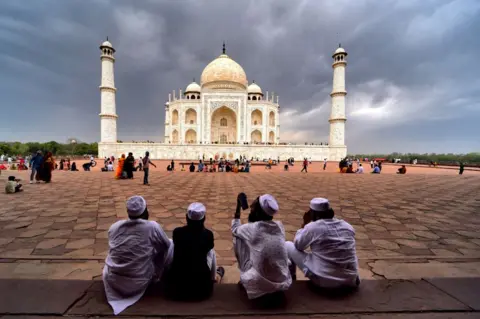
The cloak of invisibility is off and the plight of secular democracy in India is for everyone to see
Nationalism to Hindutva
In Europe, youth learn early of the terrors of nationalism and the rise of Hitler. They are taught to be suspicious of hyper-nationalism fueled by race or religion. In contrast, Indian and Pakistani youth learn only of national pride and local heroes. M.S. Golwalkar, in his 1939 work, controversially argued that only Hindus were truly Indian. He claimed non-Hindus were citizens only if they discarded their faith for Hindu customs; otherwise, they were second-class. Savarkar, the ideological father of the movement, included Sikhs and Buddhists in his ‘parivar’ but excluded Muslims. In “Hindu Rashtra Darshan” (1949), he praised Nazism as Germany’s savior, drawing parallels between German Jews and Indian Muslims. To scholar Jyotirmaya Sharma, Savarkar’s drive for a Hindu Rashtra outweighed political freedom. It is ironic that his heirs now claim the title of ‘nationalists. It is a revision of history. Once, both groups were called communal, but now Hindus have cleared themselves of blame, painting only Muslims as the community that acts only for self-interest. Hindus now represent the nation itself. As nationalism merges with Hindutva, it creates ‘enemies’-branding Muslims as traitors or leftists as ‘pseudo-secular’ urban Naxals.
Hindu Rashtra, the only way ahead?
The majority is constantly trying to actualize their dream of Hindu Rashtra but how would that be? Is it the Utopian dream or an actual planned project? Beyond the far-Right Hindutva bubble, will the mainstream Sangh Parivar leadership have the appetite for such a controversial move, given the potential reputational damage it is likely to do to India’s image as South Asia’s sole pillar of secular democracy in a region engulfed by religious and cultural strife? Truth be told, both communities are constrained by objective factors and are not really in a position to have it all their way: neither an all-singing-all-dancing secular utopia sought by Muslims, nor an in-your-face Hindu Rashtra sought by Hindu nationalists. RSS chief, Mohan Bhagwat, has said that a ‘Hindu Rashtra’ does not mean it has no place for Muslims as this concept is inclusive of all faiths and religions. He insists that the RSS is ‘not anti-minorities and doesn’t propose to change the framework of the Constitution, as alleged by the Opposition.
The Hindu Rashtra, whether Theocratic or Secular in its working, if actualized, it will surely deprive the Muslim masses of their Muslimness. As per the ideas of Golwalkar and Sarvarkar, only Hindus are to be treated as Indians, so eventually in order to fit in the ‘Indian’ State, the Muslims have to leave their Muslimness. Every Modern State has a Boogeyman of its own, for the USA, it was the communists back then. In India, Indian Muslims are the Boogeyman. The Modern State acts as a God having its own metaphysics, angels and devils. It needs uniformity among its citizens but complete uniformity is a danger in itself so the State creates a Boogeyman to balance the equation, the Satan. Muslims in India will have to bear the consequences if the Hindu Rashtra comes into effect.
