

– Ibn Samdani
In the modern world, knowledge is often equated with power, as famously stated by Francis Bacon. However, the very nature of knowledge has undergone a profound transformation. For Syed Muhammad Naquib al-Attas, “the test of true knowledge is in man himself.” Through knowledge, man comes to know himself, understands his ultimate destiny, and attains true happiness.
In his book Islam and Secularism, al-Attas discusses the nature of knowledge and identifies two distinct kinds. The first is Fard ‘Ayn knowledge, which includes the essentials of Islam – its principles, meanings, purposes, and their correct understanding and implementation in daily life. This knowledge is obligatory for every individual. The second is Fard Kifāyah knowledge, which refers to the sciences acquired through experience, observation, and research. This form of knowledge is discursive and deductive in nature and concerns objects of practical and pragmatic value. While one kind of knowledge must be acquired by every individual, the other should be acquired collectively by the community.
Al-Attas emphasizes that true education is best understood as Ta’dīb, rather than the commonly used term Tarbiyah. Tarbiyah conveys meanings such as “to nurture,” “to feed,” “to foster,” or “to cultivate,” and its application in the Arabic language is not restricted to human beings; it extends to plants, animals, and even minerals. For example, cattle farming can be described as a form of tarbiyah. Education, however, is peculiar to man alone. The qualitative elements inherent in education are fundamentally different from those involved in tarbiyah, as education entails moral, intellectual, and spiritual discipline unique to human beings.
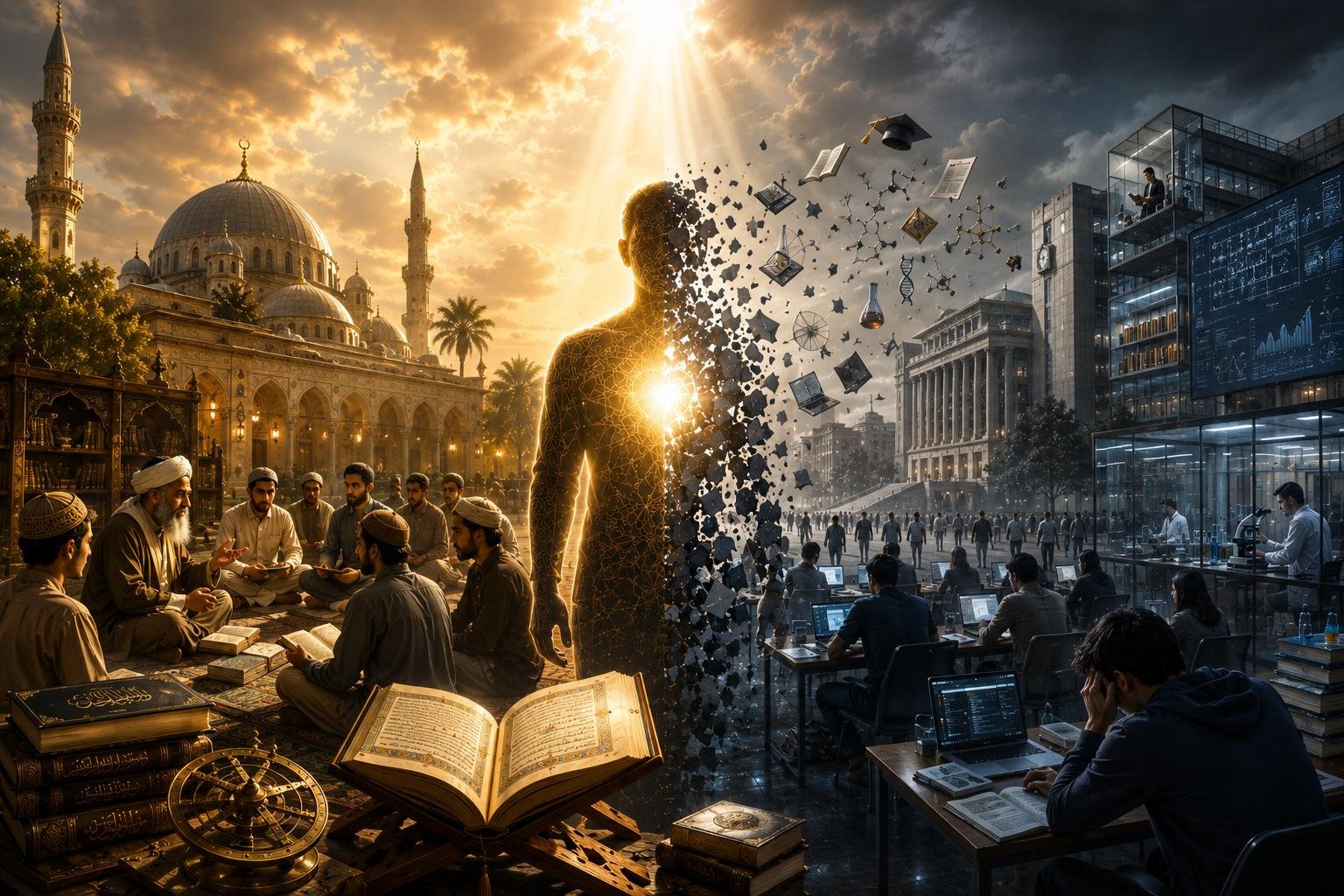
Historically, Islam established its educational system with the mosque at its center. From the earliest periods, the Masjid functioned not only as a place of worship but also as an institution of learning. Over time, other educational institutions developed, such as the Maktab Dar ul Uloom, and Madrasah, all of which remained organically connected to the mosque.

The concept of modern university is derived from Islam
Alija Izetbegović, the Bosnian intellectual, highlights this integration of religion and knowledge in his writings. He notes: “This tendency of integrating religion and science – an Islamic tendency in the best sense of the word—can be seen in the simultaneous construction of mosques and schools. The first order to build schools near mosques dates back to the second caliph, ‘Umar ibn al-Khattab, and was repeated by Caliph Harun al-Rashid (786–808). This unity of religion and science began with the very revelation of the Qur’an: Read, in the name of your Lord…”
Historical evidence supports this view. The first mosque, Masjid al-Nabawi, built by the Prophet Muhammad ﷺ himself, functioned as a school through the institution of the Suffah. According to Izetbegović, Islamic educational institutions were profoundly human in nature, as they were designed to represent man himself.
The concept of the University, derived from the Latin universitatem, mirrors the original Islamic idea of Kulliyyah, meaning totality. Al-Attas writes: “The university must have been conceived in emulation of the general structure, in form, function, and purpose, of man. It was meant to be a microcosmic representation of man—indeed, of the Universal Man (al-insān al-kullī).”
It is remarkable that both Syed Naquib al-Attas and Alija Izetbegović independently arrived at the same conception of education, comparing the university to the human being.
However, in the modern world, the university no longer reflects the wholeness of man. Like a person without personality, the modern university lacks a vital center, an abiding principle, and a final purpose. While it continues to claim universality and maintains faculties and departments as though they were organs of a body, it possesses neither a brain nor a soul. Its development is driven not by a definitive purpose but by the relentless pursuit of knowledge for its own sake—what René Guénon described as profane science. Such institutions do not lead to certainty or true knowledge; instead, they foster perpetual confusion and skepticism.
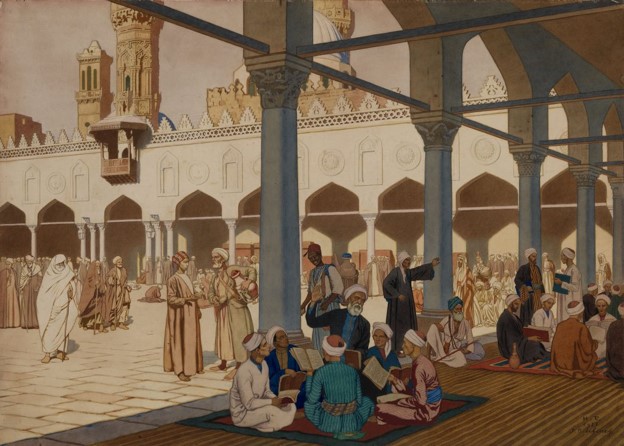
The ancient Islamic system of holistic Taaleem (Education) included the aspect of Tarbiyyah (Training) as well
As al-Attas observes: “Even if it be argued that the modern university is in fact emulating man, yet it is the secular man that is portrayed—the rational animal devoid of soul, like a circle with no center. The various faculties and departments within it have become uncoordinated, each preoccupied with its own endless pursuits.”
Maryam Jameelah expresses a similar critique in her book Islam and Western Society. She writes: “Is Western civilization conducive to human welfare from an intellectual standpoint? One of its proudest boasts is its system of universal, compulsory education. The question is: what kind of education? Western colleges and universities have become immense degree factories. Students pursue degrees not for competence in their chosen fields but merely for social and economic advantage. In view of this totally materialistic outlook, the entire Western educational system is breaking down.”
This form of “education,” which many developing countries imitate with great zeal, is worse than illiteracy. It is not education in its true sense but mis-education. Like other technological institutions, it operates in a mass, impersonal, and regimented manner, narrowing its aims to literacy and technical know-how alone. While this may serve economic interests, it fails to address the deepest human needs.
For this reason, schools in the Islamic world cannot be classified according to the European dichotomy of secular versus spiritual. Such institutions were historically considered natural, as they emerged directly from the spirit of Islam. Wherever this unity has been disrupted,
it can largely be attributed to foreign influence. The original Islamic educational model reflects the fundamental concept of the unity of religion and science. The mosque-school stands as a symbol to which nothing can be added and from which nothing can be subtracted.
The removal of God from science, transforming it into profane science, marked the turning point that led to the emergence of modern universities. By placing man at the center in place of God, knowledge was degraded into an instrument of power, reduced to its limited utility in the material world. T is cruel materialism stripped knowledge of its sacred purpose.
