

– Ayan Ahmed
Imagine a classroom where every student has access to the most knowledgeable assistant in history. It can write essays, explain physics, translate languages, generate code, and summarize entire books in seconds. That assistant is Artificial Intelligence.
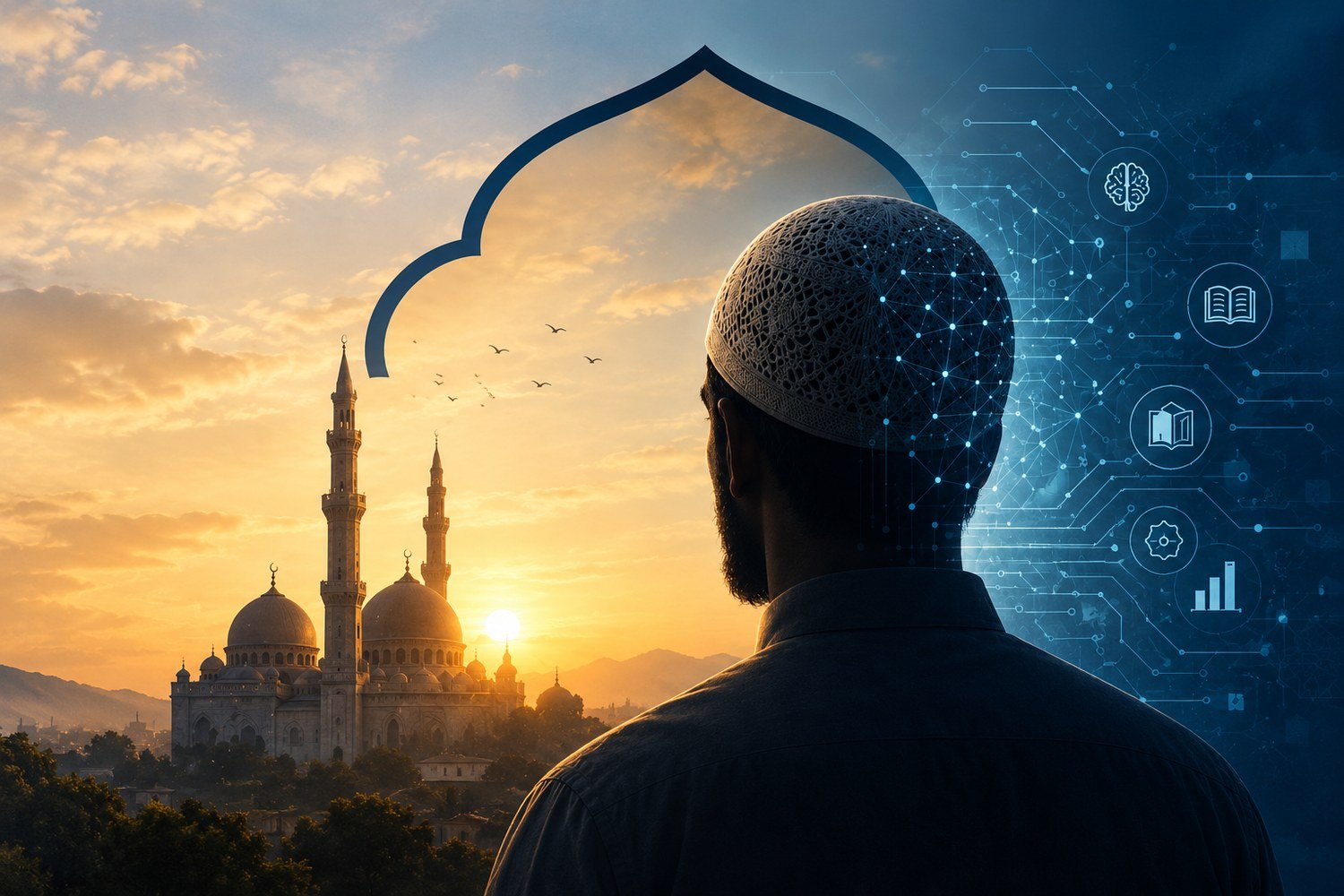
The question facing Muslims today is not whether Al is powerful. It undoubtedly is. The real question is: What kind of human being will AI produce?
For centuries, knowledge was difficult to obtain. Scholars travelled across continents to hear a single hadith or study under one teacher. Today, knowledge is abundant, but reflection is becoming scarce. We have answers before we have questions.
“Read in the name of your Lord who created.” (Qur’an 96:1)
This verse establishes a principle often forgotten in discussions about technology. Islam never separates knowledge from its source. Knowledge is not merely information, it is a trust that should bring a person closer to Allah.
Artificial Intelligence can generate information at astonishing speed, but it cannot generate Hikmah (wisdom). Wisdom comes from experience, sincerity, humility, and the ability to distinguish right from wrong. A machine can explain patience, but it cannot remain patient. It can define gratitude, but it cannot thank Allah. It can describe mercy, but it cannot show mercy. That is the difference between intelligence and consciousness.
The Qur’an repeatedly invites mankind to observe, reflect, and reason: “Indeed, in the creation of the heavens and the earth… are signs for people of understanding.” (Qur’an 3:190)
Allah does not merely encourage collecting facts; He calls us to think.
If students use AI only to complete assignments without understanding them, technology begins replacing effort rather than enhancing it. The mind slowly becomes dependent instead of disciplined. A generation that can generate answers instantly may gradually lose the habit of asking meaningful questions.

Islamically, AI is a double-edged sword. Hence, it’s important to be aware of it’s positive and negative impacts on a Muslim student’s life.
The Prophet said: “The strong believer is better and more beloved to Allah than the weak believer.” (Sahih Muslim). Strength includes intellectual strength, the ability to think independently, seek truth sincerely, and make ethical decisions.
Rejecting AI would be equally mistaken. Throughout Islamic civilization, Muslims adopted beneficial tools, from astronomy and mathematics to medicine and engineering. Technology was always a means to fulfill humanity’s responsibility on earth, never an end in itself.
“He has subjected to you whatever is in the heavens and whatever is on the earth.” (Qur’an 45:13)
A Muslim programmer can build ethical AI. A researcher can accelerate discovery. A teacher can personalize education. A doctor can improve patient care. A Da’wah worker can communicate Islam across languages. Technology becomes noble when guided by noble intentions.
Perhaps the greatest lesson AI teaches us is not about machines, it is about ourselves. Despite immense computational power, AI possesses neither a soul nor accountability. It cannot stand before Allah in prayer. It cannot repent. It cannot love its Creator.
“Indeed, We have honored the children of Adam.” (Qur’an 17:70)
Our superiority does not lie in calculating faster than computers. It lies in our ability to worship, choose righteousness, and carry moral responsibility.
As AI continues to evolve, Muslims should not ask, “Can AI think like humans?” Instead, we should ask, “Are humans still thinking as Allah intended?”
The future will not belong merely to those who build intelligent machines. It will belong to those who possess intelligent hearts, which are illuminated by revelation, disciplined by knowledge, and guided by Taqwa.
Artificial Intelligence may transform civilization, but only faith can transform the human being.
May Allah grant us beneficial knowledge, protect us from knowledge that does not benefit, and make us among those who use every technological blessing in His service. Ameen.
