

– Haider Hussaini
India is often referred to as the land of countless gods, where nearly anything imaginable can become an object of worship-even, at one point, a statue of Donald Trump. Among the wide array of deities and sacred symbols-such as the sun, rivers, trees, and stones-one animal has sparked particularly intense controversy.
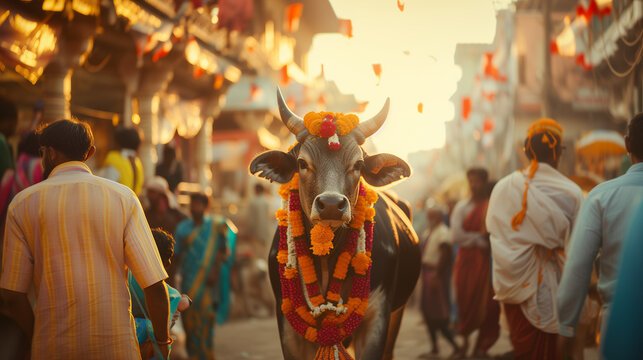
For some, the cow is sacred; for others, it’s simply food. Yet, in a country that identifies itself as a secular democracy, even citizens’ dietary choices are increasingly being regulated by the religious sentiments of the majority.
Most Indian states have now banned cow slaughter, and on-the-ground conditions are becoming more difficult. Groups like the Bajrang Dal and various Gau Rakshak (Cow Protection) outfits operate as unofficial authorities, setting up highway checkpoints, seizing cattle, beating drivers and traders, and in the most extreme cases, engaging in mob lynchings. While these groups are often backed by Hindutva politicians, many self-identified “dharmic” citizens openly support and celebrate their actions.
Over time, the cow has become a powerful political symbol-used to rally public emotion, assert religious identity, and mobilize mass support. The roots of organized Hindu Cow protection movements can be traced back to the late 19th century. In 1882, Dayanand Saraswati established the first Gorakshini Sabha (Cow Protection Society). These movements:
- Turned the cow into a symbol of Hindu unity.
- Challenged the Islamic practice of cow slaughter.
- Provoked communal riots throughout the 1880s and 1890s.
Tensions escalated further after the High Court in the North-Western Provinces ruled in 1888 that the cow was not a legally sacred object, triggering widespread violence and the deaths of hundreds.
Hindutva ideologues often link beef-eating in India to the arrival of Islam, branding it an identity marker of the Muslim community. But this conveniently ignores India’s own historical and religious past, where the cow was not always considered sacred-and beef consumption was once common.
In his book The Myth of the Holy Cow, historian D.N. Jha writes: “The communalists who have been raising a hullabaloo over the cow in the political arena do not realize that beef eating remained a fairly common practice for a long time in India and that the arguments for its prevalence are based on evidence drawn from our own scriptures and religious texts.”

In 2018, a man from Telangana built a temple of Donald Trump, making him the latest addition in the long list of deities that India has
Indeed, the earliest textual references to meat and specifically beef-consumption are found in the Vedas, the oldest religious texts of Hinduism, composed between 1500 BCE and 600 BCE during the Indo-Aryan period.
The early Aryans were nomadic pastoralists who relied heavily on cattle. Agriculture was secondary. That they were non-vegetarians is an uncontested historical fact.
Examples from the Rigveda include:
- Rigveda 10.86.14: “The worshippers dress for me fifteen (and) twenty bulls: I eat them and (become) fat, they fill both sides of my belly; Indra is above all (the world).”
- Rigveda 10.28.3: “Here, O Vasukra, cook for me a vigorous bull; for your Indra longs for bulls.”
- Rigveda 6.17.11: “You who… have had bulls cooked at their homes-so, O Indra, you eat the bulls offered by us.”
- Brihadaranyaka Upanishad 6.4.18: “If a man wishes for a learned son… then, after preparing boiled rice with meat and butter, they should eat. The meat should be of a young or of an old bull.”
In addition to textual references, archaeological excavations at sites such as Hastinapur and Atranjikhera show charred cattle bones with cut marks, indicating the cooking and consumption of beef in ancient India. At Atranjikhera, over 64% of identified animal bones were from cattle.
Ancient Ayurvedic texts also prescribe beef for medicinal purposes:
- Sushruta Samhita (c. 600 BCE) recommends beef for treating chronic respiratory conditions, fevers, emaciation, and excessive hunger. It even refers to beef as pavitra (pure).
- Charaka Samhita (compiled c. 300-200 BCE) states that beef is beneficial for treating fatigue, irregular fevers, cough, and muscle wasting.
Even Swami Vivekananda, a revered Hindu monk, acknowledged this in his writings. In Buddhistic India, he stated: “You will be astonished if I tell you that, according to the old ceremonials, he is not a good Hindu who does not eat beef. On certain occasions he must sacrifice a bull and eat it.”
In another of his works, he wrote: “The forcing of vegetarianism those who have to earn their bread by labouring day and night is one of the causes of the loss of our national freedom.”

Beef was considered to be a prestigious diet in ancient India which was served to display higher levels of hospitality to guests
How the Cow Became Sacred
During the post-Vedic period, as Aryans settled into agricultural life, the cow’s role shifted. No longer just a source of meat, the cow became indispensable for ploughing, providing manure, and yielding milk. This made the animal more valuable alive than dead.
At the same time, the growing burden of excessive animal sacrifices began to strain the economy. New religious movements-Buddhism and Jainism-began to challenge Vedic traditions. Both emphasized ahimsa (non-violence) and rejected animal slaughter. Their teachings resonated with agrarian communities, for whom protecting livestock aligned with their way of life.
To retain social influence and counter the popularity of these religions, Brahmins began to adopt the principle of non-violence as well. They reinterpreted texts and declared the cow aghnya-“not to be killed.” Initially, this applied only to milking cows, but over time it was generalized to all cows.
As the centuries passed, the sanctity of the cow evolved into a defining feature of Hindu tradition-less from divine commandment, and more as a product of historical, economic, and social change. Today, that reverence has been politicized and weaponized in deeply divisive ways.
Conclusion
With ample evidence from religious texts, archaeology, historical analysis, and expert scholarship, it becomes clear-even to a non-believer-that the sanctity of the cow is a myth, not an eternal truth that has become a tool of cultural dominance, political mobilization, and sometimes, violent exclusion.
